
How to Host a Christmas Cookie Exchange, Step by Step
To host a Christmas cookie exchange, invite a small group, ask each guest to bake one kind of cookie in a set quantity, and have everyone swap so they go home with a mixed box. Tell guests exactly how many to bring, ask for an ingredient label on every plate, and set out containers. Decide the number first, because it shapes everything else.
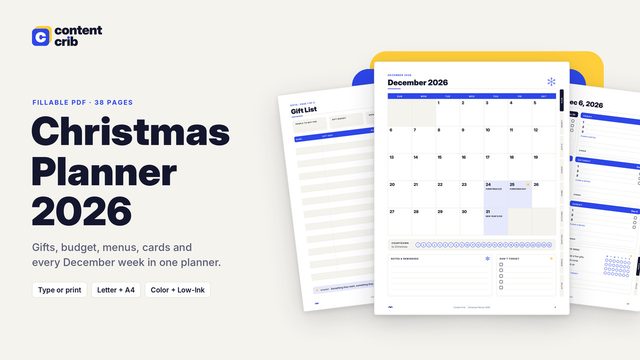 The template for thisChristmas Planner 2026 $5.60 · 30% off→
How many cookies should each person bring?
There is no official number. It is simple math that you choose as the host:
Cookies to bring = (number of guests x cookies each guest takes of each kind) + a tasting plate.
Pick how many of each kind people take home, then multiply. Here is how the math works for a few group sizes if each guest takes six of each kind and brings one extra dozen for tasting.
| Guests (including you) | To swap | For tasting | Total to bake |
|---|---|---|---|
| 6 | 36 | 12 | 48 (4 dozen) |
| 8 | 48 | 12 | 60 (5 dozen) |
| 10 | 60 | 12 | 72 (6 dozen) |
| 12 | 72 | 12 | 84 (7 dozen) |
If that is too much baking, lower the take-home number to three or four of each kind, or skip the tasting plate. Bigger groups should take fewer of each. State the final number in the invitation so nobody has to guess.
Invitations: what to include
- Date, start time and end time.
- The exact number of cookies to bring.
- "Homemade only" or "store-bought welcome," so expectations are clear.
- A request to bring a copy of the recipe or an ingredient list.
- Whether guests should bring their own container.
- A question about food allergies in the group.
- An RSVP date, and a request to tell you which cookie they plan to make, so you do not end up with six plates of the same one.
Send invitations about three to four weeks ahead. December weekends fill quickly.
Planning timeline
| When | What to do |
|---|---|
| 3 to 4 weeks before | Pick the date, set the cookie count, send invitations |
| 2 weeks before | Confirm RSVPs and each guest's cookie; ask about allergies |
| 1 week before | Buy boxes, bags, labels and drinks; choose your own recipe |
| 2 to 3 days before | Bake, or bake earlier and freeze |
| Day before | Set up the swap table, print labels, clear counter space |
| Party day | Label plates, taste, swap, pack |
Our Christmas Planner Printable includes a cookie exchange sheet, a baking plan, recipe cards, a party planner and a guest list, so the whole swap can live on a few pages next to the rest of your December plans.
Setting up the swap table
- Give each cookie its own spot with a name card and ingredient label.
- Set out tongs or a serving utensil for every plate. Keep each utensil with its own plate.
- Put containers, wax paper and bags at one end so the line moves in one direction.
- Let guests walk the table in turn, taking the agreed number from each plate.
- Keep the tasting plates on a separate table with coffee, tea or cider.
Packaging
- Bakery boxes or tins protect decorated and fragile cookies best.
- Wax or parchment paper between layers stops sticking.
- Cupcake liners make easy dividers inside a box.
- Cellophane bags work for sturdy cookies such as shortbread or biscotti.
- Keep strong flavors apart. Mint and spice cookies can flavor everything near them. Give them their own bag.
- Keep crisp and soft cookies apart so the crisp ones do not soften.
If boxes are going on as gifts, a tag with the cookie names finishes them off. The Printable Christmas Gift Tags have editable "to" and "from" lines.
Labeling allergens
Homemade cookies do not come with a package label, so the host has to ask for one. The FDA names nine major food allergens: milk, eggs, fish, crustacean shellfish, tree nuts, peanuts, wheat, soybeans and sesame. Most cookies contain at least two or three of them.
Ask every baker to write a card with:
- The cookie name and who made it.
- A full ingredient list, including sprinkles, chips and extracts.
- A clear "Contains:" line, for example "Contains: wheat, milk, eggs, tree nuts (pecans)."
- A note if it was made in a kitchen that also handles nuts or other allergens.
Dietitians at Children's Hospital of Philadelphia suggest marking dishes clearly with the specific allergen, giving each dish its own serving utensil, and placing safe dishes in a separate area where possible. They also suggest keeping food labels so guests can review them. Ask bakers to bring the packaging for chocolate chips, sprinkles and mixes if anyone in the group has an allergy.
A label helps people decide, but it is not a guarantee. A home kitchen cannot promise a cookie is free of an allergen. Guests with serious allergies should make their own call.
Food safety basics
- No raw dough. The CDC says tasting raw dough or batter can put you at risk for food poisoning. Most flour is raw and can carry germs such as E. coli and Salmonella, and so can raw eggs.
- Wash hands with soap and water after handling flour, raw eggs or surfaces they touched, as the CDC advises.
- Watch perishable fillings. University of Illinois Extension says food left between 40 and 140 degrees F for more than two hours should be thrown out. Cookies with cream cheese, custard or whipped cream fillings belong in the fridge until serving.
How long cookies keep
| Item | Where | How long |
|---|---|---|
| Baked cookies | Airtight container in the cupboard | 2 to 3 weeks |
| Baked cookies | Freezer at 0 degrees F | 8 to 12 months |
| Cookie dough | Freezer at 0 degrees F | 2 to 3 months |
The cupboard and baked-cookie freezer times come from NDSU Extension, which also notes that cookies do not need refrigeration. University of Illinois Extension gives the same 8 to 12 months for home-baked cookies in the freezer. For dough, NDSU lists 2 months and Illinois lists 3. Freezer times are about quality. Food kept at 0 degrees F stays safe as long as it has not thawed, but flavor and texture fade.
That freezer window is what makes a swap manageable. You can bake a week or two early, freeze the cookies in airtight containers, and thaw them the day before.
Frequently asked questions
How many people should I invite?
Six to ten is a comfortable size. It gives a good variety without asking anyone to bake more than a few batches.
Can guests bring store-bought cookies?
That is up to you. Say so in the invitation. Store-bought cookies have a printed ingredient label, which can help guests with allergies.
What cookies travel and keep best?
Sturdy, dry cookies such as shortbread, biscotti, gingerbread and sugar cookies travel well. Cookies with soft fillings or delicate frosting are harder to pack and may need the fridge.
Can I freeze the cookies I bring home?
Yes. Baked cookies freeze well in an airtight container. Extension guidance puts best quality at 8 to 12 months at 0 degrees F.
Sources
- FDA, The FASTER Act: Sesame Is the Ninth Major Food Allergen (2024)
- CDC, Raw Flour and Dough (2025)
- NDSU Extension, Food Storage Guide Answers the Question (FN579, reviewed 2023)
- University of Illinois Extension, Freezer Storage (read November 2026)
- University of Illinois Extension, How Important is the 2 Hour Rule? (2016)
- Children's Hospital of Philadelphia, Planning for Holiday Gatherings When Your Child Has a Food Allergy (2018)
This is general information, not medical or food safety advice for your situation.
Skip the blank page
The Christmas Planner 2026 has all of this laid out and ready to edit. $5.60, instant download.
Get the Christmas Planner 2026Related guides
- Christmas Planning Checklist: A 6-Week Countdown for 2026
- How to Make a Christmas Budget (and Stick to It)
- Christmas Gift List Organizer: How to Track Gifts, Sizes and Shipping
- Thanksgiving Games for Family: 12 Ideas for Adults and Kids at the Table
- How to Play Thanksgiving Bingo: Rules, Calling Tips and Prize Ideas