
Photography Proposal: What to Include (With Example Wording)
A photography proposal should cover seven things: the shoot details, the deliverables, usage rights, the timeline, pricing packages, the deposit and the cancellation terms. Open with a short summary of what the client wants and close with a clear next step. Photography differs from most freelance proposals in one way: the client is paying for a license to use the images as well as for your time, so the usage section needs as much care as the price.
 The template for thisFreelance Client Kit $13.30 · 30% off→
1. Overview and goals
Two or three sentences that show you understood the brief. Say what the photos are for and what a good result looks like.
Example wording: "You are launching a new menu in [month] and need images for the website, printed menus and social media. The goal is a consistent set of food and interior photos that match your existing brand colors."
2. Shoot details
This is the scope of the shoot day itself. Be specific enough that both sides can tell when the job has grown.
- Date, start time and length of the shoot
- Location, and who arranges access, permits or studio hire
- The shot list or number of setups
- Who is there: assistant, stylist, models, client contact
- What the client provides: products, props, a clean space, people to be photographed
- A weather or backup plan for outdoor shoots
Example wording: "One half-day shoot of up to [4] hours at [location], covering up to [12] dishes and [6] interior shots from an agreed shot list. The client will provide prepared dishes and a contact on site."
3. Deliverables
State exactly what the client receives, so there is no argument later about raw files or extra edits.
| Item | What to specify |
|---|---|
| Number of images | How many final edited images, and how they are chosen |
| Editing level | Color correction only, or retouching, and how much |
| File formats and sizes | For example, high-resolution files for print and smaller files for web |
| Delivery method | Online gallery or download link, and how long it stays live |
| Revisions | How many rounds of edit changes are included |
| What is not included | Raw files, extra images, prints, video |
Example wording: "You will receive [25] edited images chosen from a proof gallery, delivered as high-resolution and web-size files by download link. One round of edit changes is included. Unedited and raw files are not part of this package."
4. Usage rights and licensing
This is the section clients understand least, so write it in plain words. The starting point, according to the U.S. Copyright Office, is that the photographer who takes the photo is generally the author and first owner of the copyright, and that protection exists from the moment the picture is taken. The main exception is a work made for hire, such as a photo taken by an employee as part of the job, where the employer or commissioning party is considered the author.
The Copyright Office describes the owner's rights as including the right to make and distribute copies, adapt the work and display it publicly. A license is how you give the client permission to do some of those things. In the proposal, spell out:
- Who can use the images: the client only, or also partners, press or parent companies
- Where: website, social media, print, advertising, packaging
- How long: a set period or with no end date
- Which region: local, national or worldwide
- Exclusive or not: whether you can license the same images to anyone else
- Your own use: whether you may show the images in your portfolio and marketing
- Credit: whether and how you are credited
Example wording: "The photographer keeps the copyright in all images. On full payment, the client receives a non-exclusive license to use the delivered images on its own website, social media accounts and printed menus, with no end date. Paid advertising, resale of the images and use by third parties are not included and can be quoted separately. The photographer may use the images in portfolio and marketing material."
If a client asks to own the copyright outright, treat that as a different and larger deal, price it accordingly and have the transfer handled in a proper written agreement.
5. Timeline
Clients mostly want to know when they will see photos. Give dates or working-day counts for each stage.
- Proposal accepted and deposit paid
- Planning call and final shot list
- Shoot day
- Proof gallery delivered
- Client selections due
- Final edited images delivered
Add one line on what happens if the client is late with selections or feedback, since that is the usual cause of delay.
6. Pricing packages
Two or three packages make it easier to say yes than a single figure. Keep the differences easy to see: shoot length, number of images and breadth of license.
| Package | Shoot | Images | License |
|---|---|---|---|
| Essential | [2] hours, one location | [10] edited images | Web and social media |
| Standard | Half day, one location | [25] edited images | Web, social media and print |
| Extended | Full day, up to two locations | [50] edited images | Web, social media, print and advertising |
List extras separately so the package price stays clean: additional images, rush delivery, travel, studio or equipment hire, assistants, extended licensing. Say whether tax is included.
7. Deposit and payment
State how much is due to book the date, when the balance is due, how to pay and what happens to image delivery if the balance is unpaid.
Example wording: "A deposit of [amount or percentage] books the shoot date. The balance is due [on the shoot day or before final images are delivered]. The license to use the images starts when the invoice is paid in full."
8. Cancellation and rescheduling
A shoot date you hold is a date you cannot sell twice. Cover both directions.
- How much notice the client must give to reschedule without a fee
- Whether the deposit is refundable, and until when
- What happens with bad weather or illness
- What happens if you have to cancel: a new date or a refund of what was paid
Example wording: "The shoot can be rescheduled once at no charge with at least [number] days' notice. If the client cancels within [number] days of the shoot, the deposit is kept. If the photographer has to cancel, the client can choose a new date or a full refund of the deposit."
These terms are where a proposal turns into a contract. Use the proposal to agree the commercial points, then have them written into a contract that fits your local law.
9. Next steps
End with one instruction and one date: how to accept, how to pay the deposit and how long the quote and the date are held.
A faster way to put it together
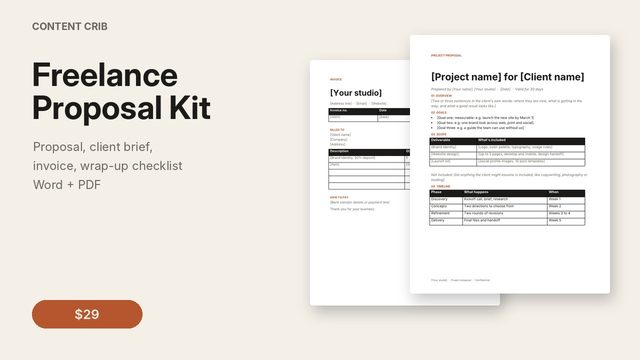
The Freelance Client Kit includes a project proposal with overview, goals, scope, timeline, investment and next steps sections, which match the outline above. Put shoot details and deliverables under scope, add usage rights as its own heading, and put packages and deposit under investment. The kit also has a client brief questionnaire to send before you quote, a service agreement template, a welcome packet, an invoice and a wrap-up checklist. The agreement is a starting template, not legal advice, so have your licensing and cancellation terms checked for where you work.
Frequently asked questions
Who owns the photos after a shoot?
According to the U.S. Copyright Office, the photographer is generally the author and initial owner of the copyright, unless the photo is a work made for hire. The client's right to use the images comes from the license you grant.
Should I include raw files?
That is your choice, but say it in the proposal either way. Most disputes come from the proposal being silent, not from the answer itself.
How long should a photography proposal be?
Two to four pages is enough for most jobs. A client should be able to find the price, the image count and the delivery date in under a minute.
Is a proposal the same as a contract?
No. A proposal sets out what you offer and for how much. A contract is the signed agreement with the legal terms. Many photographers send both, or a proposal followed by a contract once the client agrees.
Sources
- U.S. Copyright Office, What Photographers Should Know about Copyright (read 2026)
This is general information, not legal advice. Copyright and contract rules vary by country and situation, so have a lawyer review your terms.
Skip the blank page
The Freelance Client Kit has all of this laid out and ready to edit. $13.30, instant download.
Get the Freelance Client Kit