
Thanksgiving Leftovers: How Long Are They Safe to Eat?
Thanksgiving leftovers are safe for 3 to 4 days in the refrigerator, according to the USDA Food Safety and Inspection Service. Thanksgiving 2026 is Thursday, November 26, so eat, freeze or throw out refrigerated leftovers by Monday, November 30. That only holds if the food went into the fridge within 2 hours of coming off the table. This is general information, not medical advice.
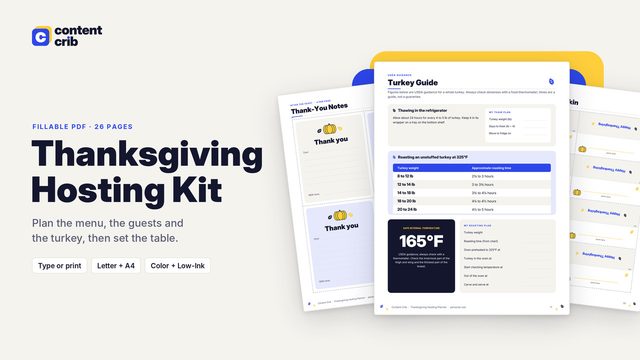 The template for thisThanksgiving Hosting Planner $4.20 · 30% off→
The short answer in one table
The times below come from the FoodSafety.gov Cold Food Storage Chart and the USDA leftovers guidance. Fridge times assume a refrigerator at 40°F or below. Freezer times assume 0°F or below.
| Food | Refrigerator | Freezer (best quality) |
|---|---|---|
| Leftover cooked turkey or other cooked meat | 3 to 4 days | 2 to 6 months |
| Soups and stews | 3 to 4 days | 2 to 3 months |
| Casseroles with eggs, after baking | 3 to 4 days | 2 to 3 months |
| Pumpkin or pecan pie, after baking | 3 to 4 days | 1 to 2 months |
| Cooked ham, slices, half or spiral cut | 3 to 5 days | 1 to 2 months |
| Egg, chicken, ham, tuna or macaroni salads | 3 to 4 days | Does not freeze well |
| Other cooked leftovers (general USDA rule) | 3 to 4 days | 3 to 4 months |
The chart does not list every side dish. For anything not named, such as stuffing, gravy or mashed potatoes, use the general USDA rule for leftovers: 3 to 4 days in the fridge.
The two-hour rule
The clock starts when food comes out of the oven or off a warming appliance, not when the meal ends. USDA says leftovers must be refrigerated within 2 hours. Perishable food that has sat at room temperature for longer than that should be thrown away.
- Why 2 hours: bacteria grow rapidly between 40°F and 140°F. USDA calls this range the Danger Zone.
- Hot weather: the limit drops to 1 hour when the air temperature is above 90°F.
- On a buffet: keep hot food at 140°F or warmer and cold food at 40°F or below. Food held at those temperatures is not on the 2-hour clock.
A long, slow Thanksgiving meal is the usual way this rule gets broken. Set a phone alarm for 2 hours after the turkey is carved, and put the food away when it rings, even if people are still picking.
How to cool and pack the turkey
A whole turkey carcass cools slowly. The goal is to get everything down to 40°F quickly, so break large items down before they go in the fridge.
- Carve the rest of the meat off the bone. USDA advises cutting leftover turkey into smaller pieces so it chills faster.
- Take the stuffing out. Store stuffing separately from the turkey in its own shallow container, even if it was cooked inside the bird.
- Use shallow containers. Divide large amounts of food, such as a pot of mashed potatoes or soup, into shallow pans or containers.
- Label each container. Write the dish and the date. A piece of tape and a marker is enough.
- Decide now what gets frozen. If you will not eat it by Monday, freeze it on day one while the quality is best.
If you host, the Thanksgiving Hosting Planner and Table Kit has a leftovers log page for exactly this: what was stored, when, and when to use it by. It also carries the turkey guide with the 165°F safe temperature, so the numbers are on paper in the kitchen.
Freezing leftovers
Freezing stops the 3 to 4 day clock. FoodSafety.gov notes that freezer times are for quality only: food kept constantly at 0°F or below stays safe indefinitely, but taste and texture decline. USDA gives 2 to 6 months as the best-quality window for frozen Thanksgiving leftovers.
- Freeze in meal-size portions so you only thaw what you need.
- Press the air out of freezer bags and lay them flat. They freeze faster and stack well.
- Freeze turkey with a little gravy or broth over it to help keep it from drying out.
- Mayonnaise-based salads do not freeze well, so eat those within the fridge window.
Thawing and reheating
USDA lists three safe ways to thaw leftovers: in the refrigerator, in cold water, or in the microwave. Thawing on the counter is not one of them.
- Refrigerator: slowest, but the food stays safe the whole time. Once thawed, use it within 3 to 4 days or refreeze it.
- Cold water: keep the food in a leak-proof package. Cook it before refreezing.
- Microwave: keep heating until the food reaches 165°F.
When reheating any leftovers, heat them until they reach 165°F on a food thermometer. Bring gravy, soups and sauces to a rolling boil. In a microwave, cover the dish, rotate or stir it, let it rest, and check the temperature in several spots, because microwaves leave cold spots.
USDA says it is safe to refreeze what is left after reheating previously frozen leftovers. In practice, reheating only the portion you plan to eat keeps the rest in better shape.
Sending leftovers home with guests
USDA advice is simple: leftovers are fine without a cooler if the trip home is 2 hours or less. For a longer drive, pack the food in a cooler with ice or frozen gel packs so it stays at 40°F or below. Pack guest containers straight from the fridge, not from the table at the end of the night.
Leftover ideas that use food up fast
The easiest way to stay inside the window is to plan two or three meals before Thursday.
- Friday: turkey sandwiches with cranberry sauce and stuffing, or a turkey and mashed potato hash for brunch.
- Saturday: turkey pot pie or a casserole that uses turkey, vegetables and gravy in one dish.
- Sunday: turkey soup. Simmer the carcass for stock, then add leftover meat and vegetables.
- Monday: last day. Freeze what is left or throw it out.
Cooking leftovers into a new dish does not restart the clock. A soup made on Sunday from Thursday turkey should still be eaten or frozen on the original schedule.
Frequently asked questions
What is the last day to eat Thanksgiving leftovers in 2026?
Monday, November 30, 2026. Thanksgiving is Thursday, November 26, and the USDA fridge limit for leftovers is 3 to 4 days. Freeze anything you want to keep longer.
Can I tell if leftovers are bad by smell?
Do not rely on it. The USDA guidance is based on time and temperature, not on how food looks or smells. If food sat out for more than 2 hours, or has been in the fridge longer than 4 days, throw it out.
Is turkey left out overnight safe if I reheat it?
No. USDA says to discard perishable food left at room temperature for more than 2 hours. Follow the time rule and do not count on reheating to fix it.
How long does frozen leftover turkey last?
It stays safe indefinitely at 0°F or below. For best quality, FoodSafety.gov lists 2 to 6 months for leftover cooked meat or poultry.
Sources
- USDA Food Safety and Inspection Service, "Leftovers and Food Safety" (read November 2026)
- FoodSafety.gov, "Cold Food Storage Chart" (read November 2026)
- USDA, "Turkey Tips Step 4: Loving Your Leftovers" (2014)
This is general information, not medical advice. If you are cooking for someone who is pregnant, elderly, very young or has a weakened immune system, follow the official guidance closely and ask a health professional if unsure.
Skip the blank page
The Thanksgiving Hosting Planner has all of this laid out and ready to edit. $4.20, instant download.
Get the Thanksgiving Hosting PlannerRelated guides
- Thanksgiving Hosting Timeline: What to Do From Two Weeks Out to Dinner
- How Long to Cook a Turkey: USDA Thawing and Roasting Times
- Friendsgiving Ideas: How to Host an Easy Potluck With a Sign-Up Sheet
- Thanksgiving Games for Family: 12 Ideas for Adults and Kids at the Table
- How to Play Thanksgiving Bingo: Rules, Calling Tips and Prize Ideas