
Debt Snowball vs Avalanche: Which Payoff Method Is Better?
The debt snowball pays off your smallest balance first, while the debt avalanche pays off your highest interest rate first. The avalanche usually costs less interest and can finish a little sooner. The snowball gives you a paid-off debt faster, which helps many people stay with the plan. Both work far better than paying minimums only.
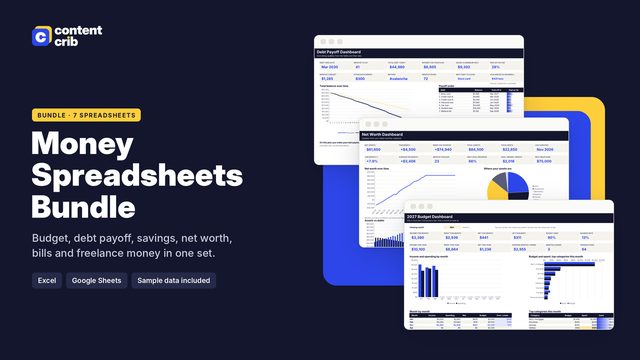 The template for thisMoney Spreadsheets Bundle $13.30 · 30% off→
How both methods work
The two methods share the same engine. You pay the minimum on every debt, then send every spare dollar to one target debt. When that debt is gone, its whole payment rolls onto the next target. The only difference is how you pick the target.
- Snowball: target the smallest balance, whatever its rate.
- Avalanche: target the highest interest rate, whatever its balance.
The rolling part matters most. If you stop rolling freed-up payments into the next debt, neither method does much.
A worked example
Take three debts and a budget of 455 a month: the three minimums (255 in total) plus 200 extra.
| Debt | Balance | Rate (APR) | Minimum |
|---|---|---|---|
| Store card | 900 | 17% | 30 |
| Credit card | 5,200 | 25% | 130 |
| Personal loan | 3,000 | 8% | 95 |
Snowball order is store card, personal loan, credit card. Avalanche order is credit card, store card, personal loan. Here is what a month-by-month schedule shows, with interest added monthly and the same 455 paid every month until the end.
| Snowball | Avalanche | Minimums only | |
|---|---|---|---|
| Months to debt-free | 25 | 24 | 87 |
| Total interest paid | 2,230 | 1,704 | 6,757 |
| First debt cleared in | Month 5 | Month 20 | Month 36 |
The minimums-only column assumes each minimum stays fixed and nothing is rolled over. In real life, card minimums often shrink as the balance falls, which makes minimums-only even slower.
What the example tells you
- Avalanche saved about 527 in interest and finished one month sooner than snowball.
- Snowball gave a win in month 5. With avalanche, the first debt did not disappear until month 20, because the target was the biggest balance.
- Either method saved more than 4,500 in interest compared with minimums only, and cut more than five years off the timeline. The extra 200 a month and the rollover do most of the work.
The gap between the two methods depends on your own numbers. If your smallest debt also has the highest rate, both methods give the same order and the same result. If your largest debt has a much higher rate than the rest, the avalanche advantage grows.
When snowball makes sense
- You have several small debts and want fewer bills to manage quickly.
- You have tried payoff plans before and lost steam.
- Your interest rates are close together, so the cost difference is small.
When avalanche makes sense
- One or two debts have much higher rates than the others.
- You are motivated by the total cost and are happy to wait for the first payoff.
- Your highest-rate debt is not also your largest by a wide margin.
A custom order is allowed
You do not have to pick a pure method. Common custom orders include clearing one tiny balance first for a quick win and then switching to highest rate, or putting a debt with a promotional rate that is about to expire at the front of the line. What matters is that you can see the cost of your choice before you commit to it.
Common mistakes
- Dropping the rollover. When a debt is cleared, the freed payment gets absorbed into everyday spending.
- Adding new balances to cards while paying them down.
- Ignoring fees and promotional periods. A 0% offer that ends in three months is not really a 0% debt.
- Switching methods every month. Pick an order, check it every few months, and change only when your numbers change.
This guide explains how the methods work. It is not financial advice. If your payments are unmanageable, a nonprofit credit counsellor or a qualified adviser can look at your full situation.
Compare both methods with your own numbers
The Content Crib Debt Payoff Planner lets you list up to 15 debts and choose snowball, avalanche or your own custom order. It builds a month-by-month schedule of up to 30 years, shows your debt-free date and the interest saved compared with minimums only, and has a compare tab that puts the methods side by side. A payment log keeps track of what you have actually paid. It works in Excel, Google Sheets and Apple Numbers.
Skip the blank page
The Money Spreadsheets Bundle includes the Debt Payoff Planner, laid out and ready to use. $13.30, instant download.
Get the Money Spreadsheets Bundle