
How to Pay Off Credit Card Debt Faster: 7 Practical Steps
The fastest way to pay off credit card debt is to stop adding to the balance, pay a fixed amount well above the minimum every month, and aim any extra money at one card at a time. Minimum payments are designed to shrink as your balance shrinks, which is why they can stretch a debt over many years.
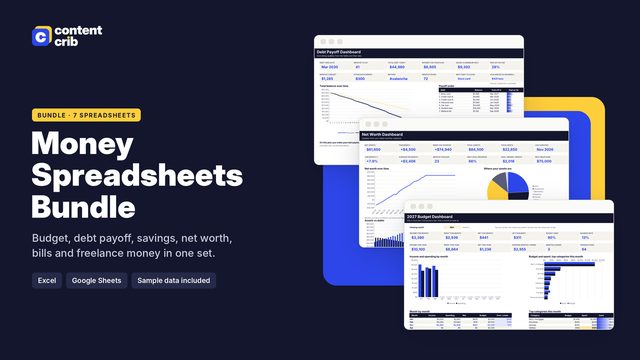 The template for thisMoney Spreadsheets Bundle $13.30 · 30% off→
Why minimum payments take so long
Many cards set the minimum as a small percentage of the balance, with a floor of a fixed amount. As you pay the balance down, the minimum goes down too, so you pay less and less each month.
Take a 6,000 balance at 23% APR with a minimum of 3% of the balance (or 25, whichever is higher). The first minimum is 180, and 115 of that is interest. Only 65 reduces the balance. Follow that pattern to the end and the card takes 226 months, almost 19 years, and costs about 9,187 in interest. The exact rules differ by card, so check your own statement.
What a fixed payment changes
Now keep paying the same amount every month instead of letting the payment fall.
| Payment on 6,000 at 23% APR | Time to pay off | Total interest |
|---|---|---|
| Shrinking minimum (3% or 25) | 226 months | 9,187 |
| Fixed 180 a month | 54 months | 3,657 |
| Fixed 280 a month | 28 months | 1,800 |
| Fixed 380 a month | 19 months | 1,214 |
Simply holding the payment at the first minimum of 180 cuts the timeline from almost 19 years to four and a half. Adding 100 on top roughly halves it again.
Seven steps to pay it off faster
- List every card. Write down the balance, interest rate, minimum payment and due date for each one. You cannot plan around numbers you have not seen.
- Stop new charges on the cards you are paying down. Move day-to-day spending to cash or a debit card while you work on the balance.
- Set a fixed total payment. Add up today's minimums, add whatever extra you can afford, and pay that same total every month even as the minimums fall.
- Pick one target card. Pay minimums on the rest and send all the extra to the target. Highest rate first saves the most interest. Smallest balance first gives the quickest win.
- Roll payments over. When the target is cleared, add its whole payment to the next card.
- Add one-off money. Refunds, bonuses and money from selling things go straight to the target card.
- Review every three months. Update balances, check your rates and move your payoff date.
Ways to find the extra money
- Cancel or pause subscriptions you rarely use and redirect the exact amount to the card.
- Pay right after payday so the money is gone before it can be spent.
- Split the payment in two. Paying half every two weeks means the balance falls sooner in the month. Where interest is charged daily, a lower average balance means slightly less interest. It also adds up to 26 half payments a year, which is 13 full payments instead of 12.
- Round up. Paying 300 instead of 280 is easy to live with and adds up.
Things to understand before lowering your rate
Lower interest means more of each payment reduces the balance. People commonly look at asking the card issuer for a lower rate, balance transfer offers, or a fixed-rate consolidation loan. Each has trade-offs: transfer fees, promotional rates that end, and the risk of running the old cards back up. Read the terms carefully and compare the total cost, not just the headline rate. Whether any of these suits you depends on your situation, and this guide is not financial advice. A nonprofit credit counsellor can go through the options with you.
Common mistakes
- Paying a bit extra on every card. Spreading the extra thinly is slower than focusing it.
- Letting the payment fall with the minimum. This is the single biggest reason card debt lingers.
- Emptying all savings to pay the card, then using the card again for the next surprise bill. A small buffer helps the plan survive.
- Not tracking. People who can see their payoff date move tend to keep going.
See your own payoff date
The Content Crib Debt Payoff Planner turns the steps above into a schedule. List up to 15 debts, choose snowball, avalanche or a custom order, and it works out a month-by-month plan of up to 30 years, your debt-free date and the interest saved compared with paying minimums only. A compare tab shows the methods side by side and a payment log records each payment you make. It works in Excel, Google Sheets and Apple Numbers.
Skip the blank page
The Money Spreadsheets Bundle includes the Debt Payoff Planner, laid out and ready to use. $13.30, instant download.
Get the Money Spreadsheets Bundle