
How Many Jobs Should You Apply for Per Week?
A common target is 10 to 15 well-matched applications a week if you are searching full time, and 3 to 5 a week if you are employed and searching on the side. The right number for you depends on your field, your experience and how many suitable roles exist. A smaller number of tailored applications usually produces more interviews than a large number of generic ones.
 The template for thisHome and Life Planning Bundle $11.90 · 30% off→
Typical ranges
| Your situation | Weekly applications | Why |
|---|---|---|
| Unemployed, searching full time | 10 to 15 | Two or three a day leaves time to tailor each one |
| Employed, searching part time | 3 to 5 | Fits around evenings and weekends |
| Senior or specialist roles | 2 to 5 | Fewer suitable openings; each needs more research |
| Entry level or high-volume fields | 15 to 25 | More openings and more competition per role |
These are starting points, not rules. Your own response rate, measured over a few weeks, is a better guide than any general figure.
Work out your own number
You can work backwards from the result you want using your funnel: the share of applications that turn into each next step.
Suppose that, from your own tracking:
- 15% of applications lead to a first call or screening.
- 50% of screenings lead to a full interview.
- 25% of interviews lead to an offer.
Then 60 applications give about 9 screenings, 4.5 interviews and roughly 1.1 offers. At 15 applications a week, that is about four weeks of applying, plus the time employers take to move through their process.
Your percentages will differ, and they change with the job market and the kind of role. The point is that once you track them, you can see what a realistic weekly target looks like and which stage is holding you back.
Read your funnel
- Lots of applications, few replies: the applications are the issue. Check that you meet the main requirements, tailor your CV to each role and apply sooner after the job is posted.
- Screenings but few interviews: practise your introduction and salary conversation.
- Interviews but no offers: work on interview preparation and ask for feedback.
- Too few suitable roles: widen the search by title, location, industry or working pattern, or put more time into contacts.
Quality beats volume
Sending 50 identical applications in a week feels productive, but generic applications get low response rates. A tailored application means:
- You meet most of the essential requirements.
- Your CV uses the same words as the job description for the skills you really have.
- The first few lines of your CV speak to this role.
- Any cover letter mentions the company and the job specifically.
That takes 30 to 60 minutes per application, which is why 10 to 15 a week is about right for a full-time search.
Applications are not the whole search
Many roles are filled through people rather than adverts. A balanced week might look like this for a full-time searcher:
| Activity | Weekly target |
|---|---|
| Tailored applications | 10 to 15 |
| Messages to contacts or new connections | 5 to 10 |
| Conversations with people in your field | 2 to 3 |
| Follow-ups on earlier applications | All that are due |
| Interview preparation | As needed |
A referral or a direct conversation with someone at the company often does more than several cold applications.
Set a weekly goal you can keep
- Make it specific. "12 applications and 5 contact messages by Friday."
- Break it down. Three applications on each of four days is easier than twelve on Sunday night.
- Count finished applications, not jobs saved for later.
- Review on the same day each week. Did you hit the goal? What came back?
- Adjust after three or four weeks based on your response rate.
How long does a search take?
It varies widely with the field, seniority and the state of the job market, and several months is not unusual. Employers also take time: weeks often pass between applying and a decision. Because of that delay, keep applying at a steady pace even when you have interviews in progress. A pipeline that empties while you wait on one employer is the most common setback.
Look after your energy
Job searching is tiring and rejection is part of it. A steady weekly target you can sustain is better than a huge week followed by two weeks of nothing. Plan search time in blocks, take full days off, and count activity you control (applications sent, people contacted) as the win, not just outcomes.
Common mistakes
- Applying to everything. Roles you are clearly not suited for waste time and morale.
- Applying to almost nothing because no job is perfect. Meeting most of the requirements is usually enough to apply.
- Not tracking. Without a record you cannot follow up, and you will not know your response rate.
- Stopping when an interview comes up.
- Never following up.
- Measuring only applications sent, not responses.
Track your weekly goal and your funnel
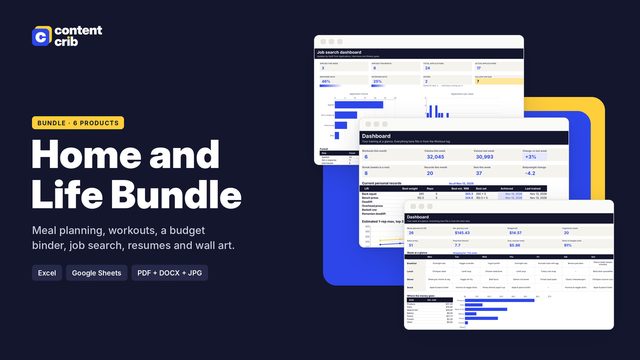
The Content Crib Job Search Tracker records applications with stages and automatic follow-up dates, plus interviews and contacts. It has weekly application goals, a funnel dashboard that shows how applications convert at each stage, and an offer comparison with a weighted score. It works in Excel, Google Sheets and Apple Numbers.
Skip the blank page
The Home and Life Planning Bundle includes the Job Search Tracker, laid out and ready to use. $11.90, instant download.
Get the Home and Life Planning Bundle