
Meal Prep for Beginners: A Simple Weekly Plan
Meal prep for beginners comes down to this: pick two or three simple recipes, cook them in one session, portion them into containers, and refrigerate what you will eat in the next three to four days. Freeze the rest. Start with lunches or dinners only, not every meal, and build from there once the routine sticks.
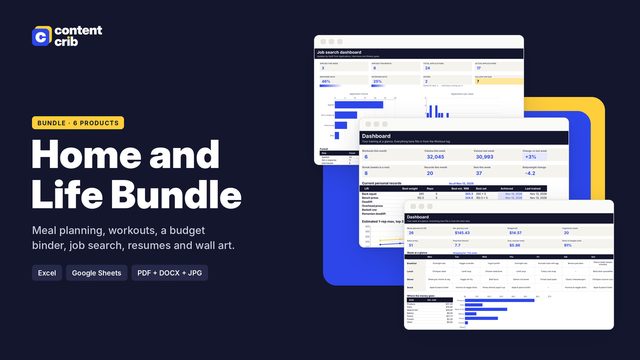 The template for thisHome and Life Planning Bundle $11.90 · 30% off→
This is general information, not medical or dietary advice. The storage times below come from US government food safety guidance.
Start small: a simple weekly plan
The most common beginner mistake is trying to prep twenty-one meals on the first Sunday. Prep one meal type for the work week and leave the rest of your eating as it is.
- Choose one meal to prep. Lunch is the usual pick, because it is the meal most often bought in a hurry.
- Pick a simple formula. One grain, one protein, two vegetables and a sauce. Change the sauce and the meal feels different.
- Write the grocery list from the recipes. Check your cupboards first so you buy only what is missing.
- Shop once.
- Cook in one session, usually on the weekend.
- Portion, label and store. Fridge for the next few days, freezer for later in the week.
Containers you need
- Single-portion containers with tight lids. USDA advises covering leftovers, wrapping them in airtight packaging or sealing them in storage containers.
- Shallow shapes. USDA says to divide large amounts of food into shallow containers so it cools faster.
- Microwave-safe and freezer-safe. Glass handles reheating well and does not stain. Plastic is lighter to carry.
- A few small pots for sauces and dressings, so salads and grains do not go soggy.
- Tape and a marker. Write the dish and the date it was cooked on every container.
Buy one size that stacks. A cupboard of mismatched lids is a reliable way to stop meal prepping.
Which foods prep well
| Preps well | Better made fresh or kept separate |
|---|---|
| Cooked grains such as rice, quinoa and pasta | Dressed leafy salads |
| Roasted vegetables | Cut avocado and apple, which brown |
| Soups, stews, chili and curry | Fried or crispy foods, which soften |
| Cooked chicken, ground meat and beans | Sauces on top of grains, until serving |
| Hard-cooked eggs | Delicate herbs, added at the end |
| Washed and chopped firm vegetables | Toast, crackers and anything crunchy |
Soups, stews and casseroles are forgiving and freeze well, which makes them good first recipes.
Safe storage times
This is the part of meal prep that many plans online get wrong. USDA says leftovers can be kept in the refrigerator for 3 to 4 days or frozen for 3 to 4 months. A full week of cooked lunches sitting in the fridge from Sunday to Friday is outside that guidance.
| Food | Refrigerator, 40 F or below | Freezer, 0 F or below |
|---|---|---|
| Leftover cooked meat or poultry | 3 to 4 days | 2 to 6 months |
| Soups and stews | 3 to 4 days | 2 to 3 months |
| Baked casseroles with eggs | 3 to 4 days | 2 to 3 months |
| Egg, chicken, ham, tuna or macaroni salad | 3 to 4 days | Does not freeze well |
| Hard-cooked eggs | 1 week | Do not freeze |
The table is from the FoodSafety.gov Cold Food Storage Chart. The chart notes that freezer times are for quality only, and that food kept continuously frozen at 0 F or below can be kept indefinitely.
The rules that go with the chart
- Two hours. USDA says to throw away perishable food left at room temperature for more than 2 hours, or 1 hour if it is over 90 F.
- The danger zone. Bacteria grow rapidly between 40 F and 140 F, so the goal is to get cooked food cold quickly.
- Hot food can go in the fridge. USDA says hot food can be placed directly in the refrigerator, or chilled quickly in an ice or cold water bath first.
- Reheat to 165 F, checked with a food thermometer. Bring soups, sauces and gravies to a rolling boil.
- Thaw safely. USDA lists the refrigerator, cold water and the microwave as safe ways to thaw leftovers.
What this means for a Sunday prep
Refrigerate the portions for Monday through Wednesday, with Thursday as the outer limit. Freeze the portions for the end of the week on Sunday, then move each one to the fridge the night before you plan to eat it. A second, smaller cook midweek is the other easy fix.
A sample prep session
This example makes five lunches and a pot of soup. The times are rough and depend on your kitchen.
- Start the slow things. Heat the oven. Put rice or another grain on to cook. Get a pot of soup or chili simmering.
- Roast. Fill one tray with chopped vegetables and another with chicken pieces or a tray of seasoned beans or tofu.
- Use the waiting time. Boil a few eggs. Wash and chop raw vegetables for snacks. Stir together one sauce or dressing.
- Portion. Divide grain, protein and vegetables into shallow containers. Keep the sauce in small pots.
- Chill promptly. Lids on, labels on, into the fridge or freezer well inside the two-hour window.
- Clean as you go, so the session ends when the food does.
Most people finish a session like this in about two hours once they have done it a couple of times.
Plan it before you shop
Meal prep works when the plan, the recipes and the grocery list agree. Our Meal Planner with Automatic Grocery List spreadsheet handles that step: you pick a recipe for each meal from a dropdown, set the servings, and the grocery list adds up the ingredients, takes off what you already have at home and sorts the rest by aisle. Each recipe carries a prep time, so you can see roughly how long the week's cooking will take before you commit to it.
Frequently asked questions
How long does meal prep last in the fridge?
USDA guidance for cooked leftovers is 3 to 4 days in a refrigerator at 40 F or below. Freeze anything you will not eat within that time.
Can I meal prep for a whole week?
Yes, if you use the freezer. Refrigerate the first three to four days of meals and freeze the rest on the day you cook. Thaw frozen portions in the refrigerator, in cold water or in the microwave.
Do I have to let food cool before refrigerating it?
No. USDA says hot food can be placed directly in the refrigerator. Dividing it into shallow containers helps it cool faster.
What should a beginner prep first?
One grain, one protein and a tray of roasted vegetables, portioned into lunches. It uses basic cooking skills and reheats well.
Sources
- USDA Food Safety and Inspection Service, Leftovers and Food Safety (accessed 2026)
- FoodSafety.gov, Cold Food Storage Chart (2023)
This is general information, not medical advice.
Skip the blank page
The Home and Life Planning Bundle includes the Meal Planner with Automatic Grocery List, laid out and ready to use. $11.90, instant download.
Get the Home and Life Planning Bundle