
How to Organize Monthly Bills So You Never Miss a Due Date
The simplest way to organize monthly bills is to list every bill by the day of the month it is due, match each one to the payday that will cover it, and check the list once a week. Seeing all your due dates in order on one page is what stops late payments, not willpower or memory.
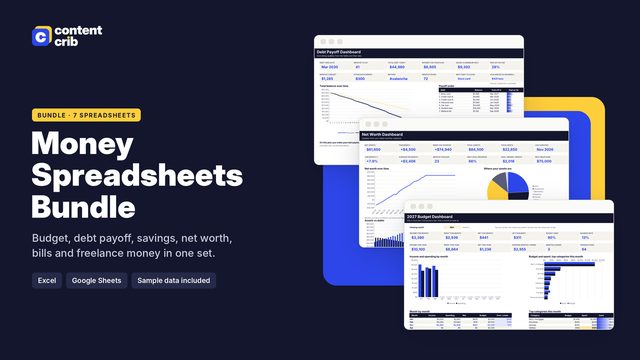 The template for thisMoney Spreadsheets Bundle $13.30 · 30% off→
Step by step
- Gather every bill. Go through one to two months of statements and note anything you pay regularly: housing, utilities, phone, internet, insurance, loans, cards, childcare, memberships.
- Record the details. For each bill write the name, usual amount, due day, how it is paid (automatic or manual) and which account it comes from.
- Sort by due day, from the 1st to the 31st.
- Mark your paydays on the same list.
- Assign each bill to a payday. Each bill is covered by the pay that arrives before it is due.
- Check that each pay period balances. If one half of the month is overloaded, ask to move a due date.
- Set a weekly five-minute check to look at what is due in the next seven days.
Worked example: matching bills to two paydays
Say you are paid 2,100 on the 1st and 2,100 on the 15th.
| Bill | Due day | Amount | Paid from |
|---|---|---|---|
| Rent | 3rd | 1,450 | Pay on the 1st |
| Internet | 6th | 62 | Pay on the 1st |
| Phone | 9th | 45 | Pay on the 1st |
| Electricity | 12th | 120 | Pay on the 1st |
| Car payment | 17th | 389 | Pay on the 15th |
| Car insurance | 20th | 140 | Pay on the 15th |
| Water | 22nd | 95 | Pay on the 15th |
| Credit card | 25th | 210 | Pay on the 15th |
| Fitness membership | 28th | 58 | Pay on the 15th |
Bills from the first pay total 1,677, leaving 423 for everything else until the 15th. Bills from the second pay total 892, leaving 1,208. The month's bills come to 2,569 in total.
The problem is obvious once it is laid out: the first half of the month is tight and the second half is loose. There are two common fixes. Ask a provider to move a due date (many will if you ask), or set aside part of the second pay each month to top up the first half. Moving 390 across would leave about 813 and 818 of spending money in each half.
Automatic or manual?
- Automatic payment suits fixed bills such as rent, loan payments and insurance, as long as the money is reliably in the account on that day.
- Manual payment suits bills that vary or that you want to check first, such as utilities after an estimated reading.
- Either way, keep the bill on your list. Automatic payments still fail when a card expires or the balance is short, and prices change without much notice.
Use a bill calendar
A bill calendar is a month grid with each bill written on its due day. It shows clusters at a glance: five bills in one week, or a quiet stretch you could move something into. Add your paydays to the same grid and you can see the gap between money arriving and money leaving.
Bills that do not come monthly
Yearly and quarterly bills cause the most trouble because they are easy to forget. Convert each one to a monthly amount and set that aside.
- A 600 yearly insurance premium is 50 a month.
- A 180 quarterly water bill is 60 a month.
- A 96 yearly membership is 8 a month.
Keeping these in a separate savings pot means the money is waiting when the bill arrives.
The five-minute weekly check
- What is due in the next seven days?
- Is there enough in the account that pays each one?
- Did last week's bills actually go out? Mark them paid.
- Has any amount changed?
- Is anything new to add?
Common mistakes
- Relying on reminder emails. They get buried or go to an old address.
- Paying everything on payday without checking due dates, which can leave you short for a bill due just before the next pay.
- Leaving yearly bills off the list.
- Not updating amounts after a price change, so the plan slowly drifts from reality.
- Scattering bills across many accounts without noting which account pays which.
If you cannot pay a bill on time
Contact the provider before the due date. Many have payment plans or can move the date, and it is usually easier to arrange before a payment is missed than after. If you are regularly short, a free money advice service can help you look at the whole picture. This guide is general information, not financial advice.
One sheet for bills and subscriptions
The Content Crib Subscription and Bill Tracker lists your monthly bills by due day and shows them on a bill calendar. It also tracks subscriptions with their billing cycle, automatic next renewal date, monthly and yearly equivalent, value rating and cancel reminders. It works in Excel, Google Sheets and Apple Numbers.
Skip the blank page
The Money Spreadsheets Bundle includes the Subscription and Bill Tracker, laid out and ready to use. $13.30, instant download.
Get the Money Spreadsheets Bundle