
How to Do Bookkeeping for a Small Business (Beginner Guide)
Small business bookkeeping means recording every amount that comes in and every amount that goes out, sorting each one into a category, and keeping proof. Do it weekly, check it against your bank statement monthly, and you will always know your profit and have clean records for tax time. A spreadsheet is enough for many sole traders and very small businesses.
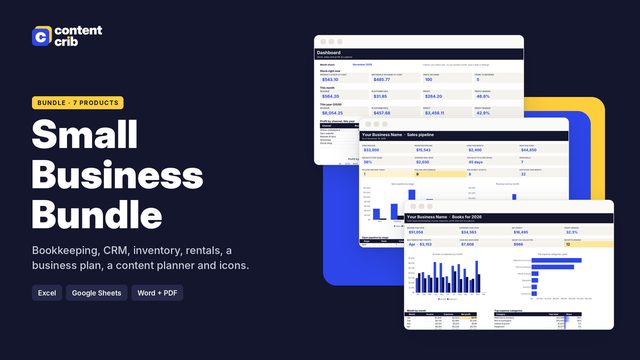 The template for thisSmall Business Spreadsheet Bundle $20.30 · 30% off→
Step by step
- Separate business and personal money. Use a dedicated bank account for the business so every line on the statement is a business transaction.
- Choose a method. Cash basis records money when it is received or paid. Accrual records it when it is earned or owed. Many very small businesses start with cash basis, but the rules on who may use it vary, so check with an accountant or your tax authority.
- Set up categories. Keep the list short. You can always split one later.
- Record income. For each payment: date, customer, description, amount, category and how it was paid.
- Record expenses. For each cost: date, supplier, description, amount, category and whether you have the receipt.
- Keep receipts and invoices. Photograph paper receipts the day you get them and file them by month.
- Reconcile monthly. Compare your records with the bank statement line by line until they match.
- Review a profit and loss summary each month and each quarter.
Categories to start with
| Income | Expenses |
|---|---|
| Product sales | Materials and stock |
| Services | Software and subscriptions |
| Shipping charged to customers | Payment and selling fees |
| Other income | Postage and shipping |
| Advertising and marketing | |
| Phone and internet | |
| Office supplies and equipment | |
| Travel and vehicle | |
| Professional fees and insurance |
If your tax return uses its own list of expense headings, matching your categories to those saves time later.
A simple routine
Weekly (15 minutes)
- Enter the week's income and expenses.
- File receipts and tick them off.
- Send invoices and note any that are overdue.
Monthly (30 to 45 minutes)
- Reconcile against the bank statement.
- Check your cash balance.
- Look at the month's profit and loss.
- Move your set-aside amount into a separate account.
Quarterly
- Review the quarter's totals and compare them with the last quarter.
- Check any filing or payment deadlines that apply to you.
Worked example: one month
In one month a small shop takes 6,200 in product sales and 1,850 for services, a total of 8,050. Its expenses are materials 1,480, software 95, selling fees 312, shipping 420, advertising 260, phone 85 and supplies 148, a total of 2,800.
Profit for the month is 8,050 - 2,800 = 5,250.
Many owners move a fixed percentage of profit into a separate account for future tax bills. If the owner has chosen 25%, that is 5,250 x 0.25 = 1,312.50. The right percentage depends on your own circumstances and where you live, so ask an accountant. This is not tax advice.
Tracking mileage
If you use your own vehicle for business, keep a mileage log. For each trip record the date, where you went, the business reason and the distance. At the end of the period, total the business distance. If you may claim a per-mile or per-kilometre rate, the claim is distance x rate. For example, 412 miles at a rate of 0.65 would be 267.80. Rates and rules are set by tax authorities and change, so check the current one for your country.
Records to keep
- Sales invoices and receipts you issue.
- Purchase receipts and supplier invoices.
- Bank and card statements.
- Mileage log.
- Records of money you put into or take out of the business.
- Stock counts, if you hold stock.
How long you must keep records depends on your country, often several years. Check the rule that applies to you.
Common mistakes
- Mixing personal and business spending in one account.
- Leaving it all to year end. Twelve months of receipts is a miserable job and details get forgotten.
- Recording only the bank deposit when a selling platform has already taken fees. Record the full sale as income and the fee as an expense.
- Counting your own drawings as an expense. Money you take out for yourself is usually not a business cost.
- Not reconciling, so errors and missed transactions build up.
When to get help
Consider an accountant or bookkeeper if you register for sales tax or VAT, take on employees, hold a lot of stock, or simply are not sure what you can claim. This guide is general information, not tax, legal or accounting advice.
A ready-made bookkeeping spreadsheet
The Content Crib Small Business Bookkeeping template has cash-basis income and expense ledgers with categories, a monthly profit and loss, a quarterly summary with a set-aside percentage that you choose, a mileage log, a cash balance view and a receipt checklist. It works in Excel, Google Sheets and Apple Numbers.
Skip the blank page
The Small Business Spreadsheet Bundle includes the Small Business Bookkeeping spreadsheet, laid out and ready to use. $20.30, instant download.
Get the Small Business Spreadsheet BundleRelated guides
- Cash Basis vs Accrual Accounting: The Difference in Plain English
- Profit and Loss Statement for a Small Business: How to Make One
- Simple CRM Spreadsheet: What to Track and How to Set It Up
- Sales Pipeline Stages Explained (With Examples for Small Business)
- How to Calculate a Weighted Pipeline (Formula and Example)