
Sales Pipeline Stages Explained (With Examples for Small Business)
Sales pipeline stages are the steps a possible sale passes through, from first contact to won or lost. A typical small business pipeline has six: new lead, contacted, qualified, proposal sent, negotiation, and closed. Each stage should have a clear rule for entering it, so you and anyone else can tell where a deal really stands.
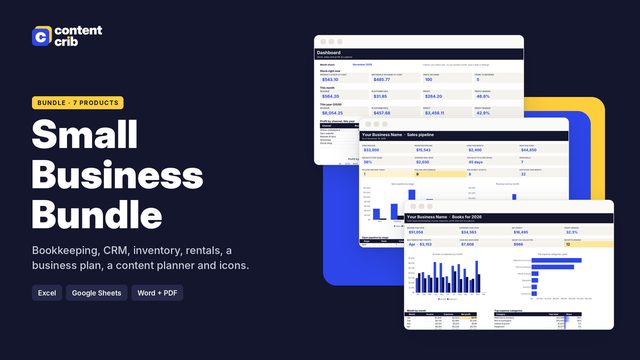 The template for thisSmall Business Spreadsheet Bundle $20.30 · 30% off→
Six stages that suit most small businesses
| Stage | What it means | Moves forward when |
|---|---|---|
| New lead | Someone has shown interest or been identified | You have made contact |
| Contacted | You have spoken or exchanged messages | You have confirmed need, budget and timing |
| Qualified | They have a real need, can pay, and can decide | You send a quote or proposal |
| Proposal sent | They have your price and terms in writing | They respond with questions or changes |
| Negotiation | You are agreeing final details | They say yes or no |
| Closed won / Closed lost | The deal is decided | Finished |
Define exit criteria
The most important part of a stage is the rule for leaving it. Good rules are based on something the buyer did, not something you did or hoped.
- Weak: "I think they are interested."
- Strong: "They confirmed a budget and a start date on a call."
Write one sentence per stage and keep it where you can see it.
What qualified means
A qualified lead is one worth your time. A simple test is four questions.
- Need: do they have a problem you solve?
- Budget: can they afford your price range?
- Authority: are you talking to the person who decides?
- Timing: do they want it within a period that makes sense?
If two or more answers are no, the lead is not ready. Park it with a later follow-up date instead of moving it forward.
Stage probabilities
Each stage can carry a probability: your estimate of how often deals at that stage end up won. These let you forecast income by multiplying each deal's value by its probability.
| Stage | Example probability |
|---|---|
| New lead | 10% |
| Contacted | 25% |
| Qualified | 50% |
| Proposal sent | 75% |
| Negotiation | 90% |
| Closed won | 100% |
| Closed lost | 0% |
These are starting points only. After a few months, replace them with your own history. If you sent 20 proposals and won 8, your real proposal-stage probability is 40%, not 75%.
Adapting stages to your business
- Service business: add a discovery call or site visit stage before the proposal.
- Product or wholesale: add a sample sent stage.
- Quick sales: merge contacted and qualified, and skip negotiation.
- Long sales: split negotiation into verbal yes and contract sent.
Keep the total between four and seven. More stages than that and you spend your time moving cards instead of talking to customers.
Reading your pipeline
- Where do deals pile up? A crowd at proposal sent usually means follow-up is weak or pricing is unclear.
- Where do deals die? If most are lost after the first call, look at where your leads come from.
- How long does each stage take? A deal sitting twice as long as usual is at risk.
- Is the top filling? A pipeline with nothing in the first two stages means a quiet period is coming in a month or two.
Worked example
You have five open deals: 4,000 at new lead, 2,500 at contacted, 6,000 at qualified, 1,800 at proposal sent and 3,200 at negotiation. The total pipeline is 17,500. That does not mean you will win 17,500. Weighted by the probabilities above, the forecast is 400 + 625 + 3,000 + 1,350 + 2,880 = 8,255.
Common mistakes
- Stages based on your activity, such as "emailed twice", instead of the buyer's commitment.
- Skipping qualification. Sending proposals to everyone feels productive and wastes hours.
- Never marking deals lost. If there has been no reply after your full follow-up sequence, close it. You can reopen it later.
- Not recording why you lost. Price, timing, went elsewhere, no decision. After ten losses a pattern appears.
- No next step. Every open deal needs a next action and a date.
A weekly pipeline review
- Go through each open deal, oldest first.
- Confirm the stage still matches reality.
- Check there is a next action with a date.
- Close anything that is dead.
- Count new leads added this week.
A pipeline in a spreadsheet
The Content Crib Small Business CRM includes a deals list with stage probabilities, a weighted pipeline, a contacts list, follow-ups due, an activity log and a monthly report. It works in Excel, Google Sheets and Apple Numbers.
Skip the blank page
The Small Business Spreadsheet Bundle includes the Small Business CRM and Sales Pipeline, laid out and ready to use. $20.30, instant download.
Get the Small Business Spreadsheet BundleRelated guides
- How to Do Bookkeeping for a Small Business (Beginner Guide)
- Cash Basis vs Accrual Accounting: The Difference in Plain English
- Profit and Loss Statement for a Small Business: How to Make One
- Simple CRM Spreadsheet: What to Track and How to Set It Up
- How to Calculate a Weighted Pipeline (Formula and Example)