
Simple CRM Spreadsheet: What to Track and How to Set It Up
A simple CRM spreadsheet needs four things: a list of contacts, a list of deals with a stage and value, a next follow-up date for every open deal, and a log of what was said. If you can open the sheet each morning and see who to contact today, it is doing its job. Most small businesses do not need anything more complicated to start.
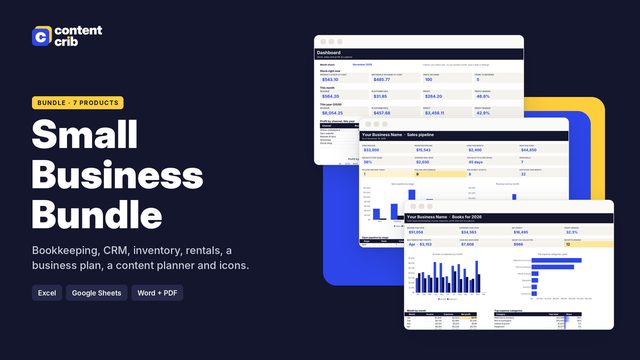 The template for thisSmall Business Spreadsheet Bundle $20.30 · 30% off→
What a CRM is for
CRM stands for customer relationship management. In practice it answers three questions.
- Who are my leads and customers?
- Where is each possible sale up to?
- Who do I need to contact next, and when?
Sales are usually lost through silence, not rejection. Someone asks for a quote, you send it, and nobody follows up. A CRM exists to stop that.
The four lists
1. Contacts
- Name and company
- Email and phone
- Where they came from (referral, website, event, social media)
- Type: lead, customer, past customer, partner
- Notes
2. Deals
- Deal name and contact
- Value
- Stage
- Expected close date
- Next action and next follow-up date
3. Follow-ups
A view of every open deal sorted by next follow-up date, with overdue ones flagged. This is the page you look at every day.
4. Activity log
One line per call, email or meeting: date, contact, what happened, what was agreed. When a lead goes quiet for two months and then replies, the log tells you where you left off.
Keep stages few
Five or six stages is plenty: new lead, contacted, qualified, proposal sent, negotiation, then won or lost. Each stage should mean something specific has happened, not how hopeful you feel.
A follow-up cadence that works
A cadence is a planned sequence of follow-ups, so you never have to decide whether it is too soon. One reasonable pattern after sending a proposal:
| Touch | When | What |
|---|---|---|
| 1 | Day 0 | Send the proposal with a clear next step |
| 2 | Day 2 to 3 | Short check that it arrived, offer to answer questions |
| 3 | Day 7 | Add something useful: an example, a case, an answer to a likely concern |
| 4 | Day 14 | Ask directly whether timing has changed |
| 5 | Day 30 | Polite closing note; leave the door open |
Adjust the gaps to your sales cycle. A 200 purchase moves faster than a 20,000 one. The rule that matters is: no open deal without a next follow-up date.
Your daily and weekly routine
- Daily (5 minutes): open the follow-ups view, contact everyone due today or overdue, log what happened, set the next date.
- Weekly (20 minutes): review every open deal. Update stages, close out dead ones as lost, and check each has a next step.
- Monthly: count new leads, deals won, deals lost and total value won. Note why deals were lost.
Numbers worth watching
- New leads per month.
- Win rate: deals won divided by deals closed (won plus lost).
- Average deal value.
- Open pipeline value and weighted pipeline value.
- Overdue follow-ups. This should be zero most days.
As a quick example of how the funnel narrows: 40 new leads, of which 25% are qualified (10), half of those get a proposal (5), and 40% of proposals are won (2). That is 2 sales from 40 leads, a 5% lead-to-sale rate. Knowing your own rates tells you how many leads you need for the sales you want.
Common mistakes
- Too many columns. If adding a contact takes five minutes, you will stop doing it.
- Never closing deals as lost. A pipeline full of dead deals looks healthy and is not.
- Notes in your head or inbox. If it is not in the log, it did not happen.
- No source column. Without it you cannot tell which marketing actually brings customers.
Privacy basics
A contact list is personal data. Keep only what you need, store the file somewhere secure, and remove people who ask to be removed. Data protection rules differ by country, so check the ones that apply to you. This is not legal advice.
When a spreadsheet stops being enough
Consider dedicated software when several people need to edit at once all day, when you want emails logged automatically, or when you have thousands of contacts. Until then, a well-kept spreadsheet is faster to learn and costs nothing to run.
A ready-made CRM spreadsheet
The Content Crib Small Business CRM has a contacts list, a deals list with stage probabilities, a weighted pipeline, a view of follow-ups due, an activity log and a monthly report. It works in Excel, Google Sheets and Apple Numbers.
Skip the blank page
The Small Business Spreadsheet Bundle includes the Small Business CRM and Sales Pipeline, laid out and ready to use. $20.30, instant download.
Get the Small Business Spreadsheet BundleRelated guides
- How to Do Bookkeeping for a Small Business (Beginner Guide)
- Cash Basis vs Accrual Accounting: The Difference in Plain English
- Profit and Loss Statement for a Small Business: How to Make One
- Sales Pipeline Stages Explained (With Examples for Small Business)
- How to Calculate a Weighted Pipeline (Formula and Example)