
Craft Fair Sales and Inventory Tracking: A Simple System
To track craft fair sales and inventory, count every item before you leave, record each sale as it happens, and count again when you get home. The difference between the two counts should match your sales record. Then subtract materials, fees and the cost of doing the show to see what you really made. The whole system fits on one sheet of paper or one spreadsheet tab.
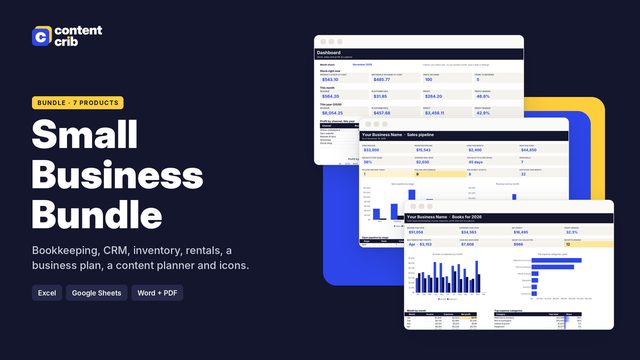 The template for thisSmall Business Spreadsheet Bundle $20.30 · 30% off→
Before the show: build a packing list you can count against
Your packing list is also your starting inventory. Craftybase, which makes inventory software for makers, recommends a stocktake before you leave that lists each item by SKU, quantity and price. Without a starting count you cannot tell later whether something sold, broke, was stolen or was never packed.
- Give every product a short code. A SKU such as MUG-BLU or CARD-05 is faster to write at a busy table than a full name.
- Record the quantity packed for each code, per box if you bring several boxes.
- Put a clear price on everything. It speeds up sales and means your tally and your price list agree.
- Know your unit cost. You need the materials and packaging cost of each item to work out profit afterward.
How much inventory to bring
There is no exact answer, but two published rules of thumb give you a range to start from.
- A multiple of the booth fee. Craftybase suggests bringing stock worth 5 to 10 times the booth fee at retail prices. For a 150 dollar booth, that is roughly 750 to 1,500 dollars of product.
- The 75 percent test. Made Urban suggests bringing enough that selling 75 percent of it would cover all your show costs and leave a profit. You will rarely sell everything, and a half-empty table puts shoppers off.
Made Urban also offers a way to sanity-check your number from foot traffic: expected shoppers times 2 percent gives an estimated number of sales. The article describes 2 percent as conventional wisdom that you should adjust for your product, prices and competition, so treat it as a rough guide. If the organizer expects 2,000 visitors, that is about 40 sales. Whatever number you land on, Made Urban recommends adding a buffer of 25 to 100 percent so the display still looks full late in the day.
Two practical limits matter as much as the math: how many pieces you can actually make before the date, and how much fits on your table and in your vehicle. Made Urban suggests taping out the booth size at home and doing a trial setup.
Bring a spread of prices too. Craftybase suggests a few items under 20 dollars, a middle range of 30 to 80 dollars and a couple of pieces over 100 dollars.
During the show: record every sale
Pick one method and stick to it all day.
- Tally sheet. A printed list of your SKUs with space for tick marks. One tick per item sold. It works with no signal and no battery.
- Card reader history. If you ring items up by name in your payment app, card sales record themselves. Cash sales do not, so write those down by hand.
- Notebook. Time, item, price and cash or card. Slower, but it also shows you when the busy hours were.
Whichever you choose, record cash and card sales the same way, and note any discounts, bundles or freebies when they happen. Those are the lines that make counts disagree later.
On payments, Craftybase suggests a cash float of 100 to 150 dollars in small notes, a tested card reader and a backup device with the payment app signed in. It also notes that card processing fees run roughly 2.6 to 3.5 percent per transaction, which belongs in your profit math.
After the show: reconcile and find your real profit
Do this the same day or the next morning, while you still remember what happened.
- Count what came home. Starting count minus ending count should equal units sold on your tally. Chase any gaps now.
- Total your sales. Cash counted minus your float, plus card sales.
- Subtract cost of goods. Materials and packaging for the units that sold, not for everything you made.
- Subtract show costs. Craftybase lists the booth fee, parking, food, gas, packaging used, payment processing fees and any supplies bought for the show.
- Look at what is left. That is your profit for the event before paying yourself for the hours.
A worked example
These numbers are invented to show the method.
| Line | Amount |
|---|---|
| Sales (42 items) | 1,180 |
| Materials and packaging for items sold | -330 |
| Card fees | -28 |
| Booth fee | -150 |
| Parking, gas and food | -45 |
| Profit before your time | 627 |
If you spent 9 hours selling and setting up, that is about 70 dollars an hour before counting the hours spent making the stock. Running the same sum for every show is how you learn which events are worth rebooking.
Post-show review: five questions
- Which three products sold the most units, and which made the most profit? They are often different.
- What did not sell at all? Was it price, display position or the wrong crowd?
- What did people ask for that you did not have?
- Did you run out of anything, and at what time of day?
- After all costs, would you do this show again?
Write the answers down next to the numbers. Notes from last year are the best guide to how much to bring next year.
Keeping it in one place
If you sell online as well, a fair is just another sales channel. In our Inventory & Profit Tracker for Makers and Resellers you can add a channel such as Craft fair in Settings with its own fee percentage, log each sale on the Sales tab with the SKU and quantity, and the sheet fills in the fee, cost of goods and profit. The Stock tab shows what is left per product and the dashboard charts profit by channel. Booth fees and travel are not sale-by-sale costs, so subtract those yourself from the channel total, as in the example above.
Frequently asked questions
How much inventory should I bring to my first craft fair?
Start with a published rule of thumb, such as stock worth 5 to 10 times the booth fee at retail, then cut it back to what you can make in time and fit on your table. After one show you will have your own numbers, which beat any formula.
What is the easiest way to track sales at a booth?
A printed tally sheet of your SKUs with tick marks. It is quick, works without signal and makes the after-show count simple. Add your card reader history as a cross-check.
Do I count unsold stock as a loss?
No. Unsold items are still inventory you can sell later. Only the materials in the items that sold are a cost of this show.
How do I know if a craft fair was worth it?
Subtract cost of goods and every show cost from your sales, then divide what is left by the hours you spent. Compare that figure across shows.
Sources
- Made Urban, How Much Inventory To Bring to a Craft Show (Simple Formulas) (2021, updated 2024)
- Craftybase, How to Prepare for Your First Craft Show: A Complete Step-by-Step Guide (2018, updated)
This is general information, not tax or financial advice. The inventory rules above are rules of thumb from the sources listed, not guarantees.
Skip the blank page
The Small Business Spreadsheet Bundle includes the Inventory and Profit Tracker, laid out and ready to use. $20.30, instant download.
Get the Small Business Spreadsheet BundleRelated guides
- How to Do Bookkeeping for a Small Business (Beginner Guide)
- Cash Basis vs Accrual Accounting: The Difference in Plain English
- Profit and Loss Statement for a Small Business: How to Make One
- Simple CRM Spreadsheet: What to Track and How to Set It Up
- Sales Pipeline Stages Explained (With Examples for Small Business)