
How to Categorize Business Expenses (Schedule C Categories)
The simplest way to categorize business expenses is to copy the categories the IRS already uses. If you are a sole proprietor in the US, your expenses end up on Schedule C, which has a fixed list of expense lines. Set up your books with those same names, put each purchase in one category, and tax time becomes a matter of copying totals across.
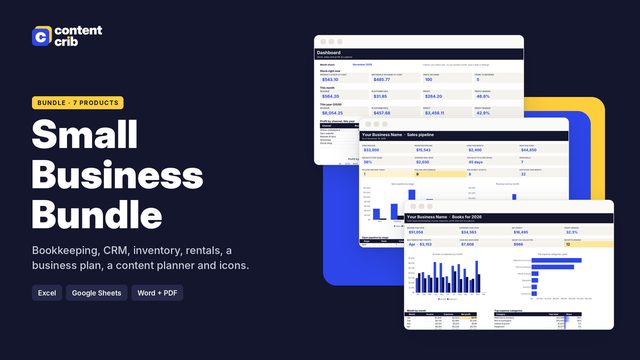 The template for thisSmall Business Spreadsheet Bundle $20.30 · 30% off→
Why match your categories to Schedule C
Schedule C is the form sole proprietors use to report income or loss from a business. Part II of the form lists expense lines such as advertising, insurance and supplies. If your spreadsheet uses different names, you have to sort everything again at the end of the year. If it uses the same names, you do the sorting once, when the purchase happens and you still remember what it was for.
The main Schedule C expense categories
These line names come from Schedule C. The examples are common ones. The IRS Instructions for Schedule C have the full rules for each line.
| Category (Schedule C line) | What usually goes here |
|---|---|
| Advertising (line 8) | Online ads, business cards, flyers, sponsored posts |
| Car and truck expenses (line 9) | Business miles at the standard mileage rate plus parking and tolls, or actual vehicle costs |
| Commissions and fees (line 10) | Commissions and fees you pay to others |
| Contract labor (line 11) | Payments to people who are not your employees, such as independent contractors |
| Depreciation (line 13) | The cost of equipment and furniture, deducted over time or under section 179 |
| Insurance (line 15) | Business insurance premiums, other than health insurance |
| Interest (lines 16a and 16b) | Interest on a business mortgage or other business debt |
| Legal and professional services (line 17) | Accountant and attorney fees tied to the business |
| Office expense (line 18) | Office supplies and postage |
| Rent or lease (lines 20a and 20b) | Leased vehicles, machinery and equipment on 20a; other property such as office space on 20b |
| Repairs and maintenance (line 21) | Incidental repairs that do not add value or extend the life of the property |
| Supplies (line 22) | Materials and supplies you used up during the year |
| Taxes and licenses (line 23) | Business taxes, licenses and fees. Not income tax or self-employment tax |
| Travel (line 24a) | Lodging and transportation for overnight business trips |
| Deductible meals (line 24b) | Business meals, which are 50% deductible in most cases |
| Utilities (line 25) | Utility costs for the business only |
| Wages (line 26) | Wages paid to employees. Not money you pay yourself |
| Other expenses (line 27) | Ordinary and necessary business costs that fit no other line, listed one by one in Part V |
| Business use of your home (line 30) | Home office costs, by actual expenses on Form 8829 or the simplified method |
Schedule C also has lines for depletion, employee benefit programs, and pension and profit-sharing plans. Most very small businesses leave those blank.
Categories people get wrong
- Equipment is not a supply. The instructions say not to list the cost of business equipment or furniture under other expenses. Bigger purchases that last for years are handled through depreciation or section 179 on line 13.
- Products you resell are not expenses in Part II. If you make or buy goods to sell, those costs go to cost of goods sold in Part III of the form. The Supplies line is labeled "not included in Part III" for this reason.
- Meals are separate from travel. A hotel goes on line 24a. The dinner on the same trip goes on line 24b, because meals are generally only 50% deductible.
- Paying yourself is not wages. Line 26 excludes amounts paid to yourself. Track owner draws apart from expenses so they do not shrink your profit on paper.
- Personal spending stays out. Personal, living and family expenses are not business expenses. Charitable contributions do not go on Schedule C either, and fines or penalties paid to a government for breaking a law are not deductible.
- Mileage needs its own log. The standard mileage rate was 70 cents per business mile for 2025, and the IRS set it at 72.5 cents for 2026. The rate changes, so log the miles and apply the rate for the right year.
- The home office has a shortcut. The simplified method allows $5 per square foot of space used regularly and exclusively for business, up to 300 square feet.
A five-step routine
- Write your category list once. Start from the table above and delete lines you will never use.
- Add plain sub-labels if they help. "Software" or "Shipping" are fine as your own labels. Just decide up front which Schedule C line each one rolls into.
- Record each expense when it happens. Note the date, who you paid, what it was, the amount and the category.
- Give every expense one category. If a receipt mixes business and personal items, record only the business part.
- Review monthly. Look for uncategorized items and missing receipts while you can still fix them.
Our Small Business Bookkeeping Spreadsheet is built around this routine. Each expense row has a dropdown category, the Settings tab lets you edit the category list and map each category to a report group, and the Receipt checklist lists every expense still missing a receipt. The default categories are general ones, so rename them to match the lines you use.
What records to keep
IRS Publication 583 says the law does not require a particular kind of record. You can use any system that clearly shows your income and expenses. It does list the supporting documents to keep:
- Income: invoices, bank deposit slips, receipt books, credit card charge slips and Forms 1099-NEC and 1099-MISC.
- Purchases of goods to resell: invoices, canceled checks and card slips that show the amount paid and that it was for inventory.
- Expenses: invoices, receipts, account statements, canceled checks and card slips.
- Assets: when and how you got the item, what it cost, any improvements, depreciation taken, and how and when you sold or disposed of it.
The publication also recommends a separate business checking account. A bank or card statement can prove you paid, but the IRS notes that proof of payment alone does not establish a deduction. Keep the invoice or receipt as well. If you pay cash and cannot get a receipt, write an explanation at the time. Electronic records are acceptable when the system stores them accurately and can reproduce them in a readable form.
How long to keep business records
| Situation | Keep records for |
|---|---|
| Most returns | 3 years |
| You file a claim for a credit or refund after filing | 3 years from filing or 2 years from paying the tax, whichever is later |
| You left out income worth more than 25% of the gross income on your return | 6 years |
| You claim a bad debt deduction or a loss from worthless securities | 7 years |
| Employment tax records | At least 4 years after the tax is due or paid, whichever is later |
| No return filed, or a fraudulent return | Indefinitely |
Records for equipment and other property follow a different clock. The IRS says to keep them until the period of limitations ends for the year in which you dispose of the property.
Frequently asked questions
What if an expense fits two categories?
Pick the line that describes it best and use the same choice every time. Consistency matters more than a perfect answer, because the totals all feed the same expense total.
Where do software subscriptions go?
Schedule C has no software line. Many filers list subscriptions under other expenses with a clear label. Ask a tax professional if a subscription is a large cost for you.
Do I need paper receipts?
No. Scans and photos are fine when they are complete, readable and stored so you can find them. Keep them organized by year and by type of expense.
Can I use these categories if I am not a sole proprietor?
They still make a sensible starting list, but partnerships and corporations file different forms with their own lines. Match your categories to the form your business files.
Sources
- IRS, Schedule C (Form 1040), Profit or Loss From Business, 2024
- IRS, Instructions for Schedule C (Form 1040), 2025
- IRS, Publication 583, Starting a Business and Keeping Records, revised December 2024
- IRS, How long should I keep records?, page updated June 2026
- IRS, news release: IRS sets 2026 business standard mileage rate at 72.5 cents per mile, up 2.5 cents
This is general information, not tax advice. Line numbers and limits can change from year to year, so check the current form and instructions or ask a tax professional.
Skip the blank page
The Small Business Spreadsheet Bundle includes the Small Business Bookkeeping spreadsheet, laid out and ready to use. $20.30, instant download.
Get the Small Business Spreadsheet BundleRelated guides
- How to Do Bookkeeping for a Small Business (Beginner Guide)
- Cash Basis vs Accrual Accounting: The Difference in Plain English
- Profit and Loss Statement for a Small Business: How to Make One
- Simple CRM Spreadsheet: What to Track and How to Set It Up
- Sales Pipeline Stages Explained (With Examples for Small Business)