
Landlord Expense Categories and a Simple Rent Roll Template
Landlords need two core records: a rent roll that shows who rents each unit, what they pay and when their lease ends, and an expense log sorted into consistent categories. With those two, you can see what each property earns, spot late rent quickly and hand clean figures to an accountant at tax time.
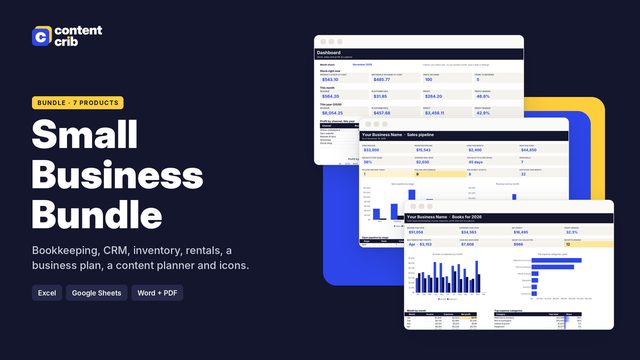 The template for thisSmall Business Spreadsheet Bundle $20.30 · 30% off→
Landlord expense categories
These categories cover most rental properties. Use the same list for every property so you can compare them.
| Category | Examples |
|---|---|
| Mortgage interest | The interest part of loan payments (tracked separately from principal) |
| Property taxes | Local property or council taxes paid by the owner |
| Insurance | Landlord buildings and liability cover |
| Repairs and maintenance | Plumbing, electrical, appliance repair, repainting |
| Management fees | Agent or property manager charges |
| Utilities | Water, electricity, gas, internet paid by the owner |
| Cleaning and grounds | End-of-tenancy cleaning, gardening, snow clearing, pest control |
| Advertising and letting | Listings, tenant screening, letting fees |
| Legal and professional | Accountant, solicitor, licence and inspection fees |
| Association or service charges | Building or community fees |
| Travel | Trips to the property for inspections and repairs |
| Supplies | Keys, smoke alarms, light bulbs, small tools |
| Capital improvements | New roof, new kitchen, extension |
Keep capital improvements separate from repairs. They are usually treated differently for tax and are left out of net operating income. What you can claim, and how, depends on your country's rules. Check with an accountant; this guide is not tax advice.
What to record for every expense
- Date
- Property and unit
- Category
- Supplier
- Amount
- Short description
- Whether you have the receipt
Tagging each expense to a property is what lets you build a profit and loss per property later.
What is a rent roll?
A rent roll is a one-page summary of every unit you let. It is the first thing a lender, buyer or accountant asks for.
| Column | Why it matters |
|---|---|
| Property and unit | Identifies the space |
| Tenant name | Who is responsible for the rent |
| Monthly rent | The agreed amount |
| Rent due day | When it becomes late |
| Lease start and end | When to discuss renewal |
| Deposit held | What must be returned or accounted for |
| Status | Occupied, vacant, notice given |
| Balance owed | Any arrears |
A 12-month rent ledger
The rent roll says what should be paid. A rent ledger shows what was paid. The clearest layout is a grid with one row per unit and one column per month. Each cell holds the amount received.
For example, a unit let at 1,800 that pays in full for ten months, pays 900 one month and is vacant for one month collects 18,900 against a possible 21,600. That is 87.5% collected, and the grid shows at a glance which months caused the gap.
For each payment also record the date received and the method, so late payments are documented.
Maintenance log
A maintenance log is separate from the expense list. It tracks the job, not just the cost.
- Date reported and who reported it
- Property and unit
- Description of the problem
- Priority
- Contractor used
- Date completed
- Cost
This protects you if there is ever a dispute about how quickly something was fixed, and it shows which properties or appliances keep costing money.
Lease dates to watch
Note each lease end date and review it well in advance, commonly 60 to 90 days, so you have time to agree a renewal, adjust the rent within the rules, or find a new tenant. Notice periods and rules on rent changes are set by law and vary widely, so check the rules where your property is.
A monthly routine
- Record rent received against each unit.
- Chase anything unpaid after the due day, following your lease terms and local rules.
- Enter the month's expenses with receipts.
- Update open maintenance jobs.
- Check leases ending in the next three months.
- Glance at each property's income and expenses for the year so far.
Common mistakes
- One bank account for personal and rental money. A separate account makes every statement line a rental transaction.
- Lumping all properties together. One property can quietly lose money behind another's profit.
- Recording the whole mortgage payment as an expense. Principal and interest are different things.
- Mixing deposits with rent. A deposit is money held, not income, and many places have rules on how it must be kept.
- No receipts. Photograph them the day you get them.
- Forgetting small recurring costs such as licence renewals and safety checks.
This is general information, not legal or tax advice. Landlord and tenant law differs by location.
All of it in one workbook
The Content Crib Rental Property Manager handles up to 10 properties with units and tenants, a rent ledger with a 12-month grid, an expense log and a maintenance log. It builds a profit and loss per property with NOI, cap rate and cash-on-cash return, and raises lease end alerts. It works in Excel, Google Sheets and Apple Numbers.
Skip the blank page
The Small Business Spreadsheet Bundle includes the Rental Property Manager, laid out and ready to use. $20.30, instant download.
Get the Small Business Spreadsheet BundleRelated guides
- How to Do Bookkeeping for a Small Business (Beginner Guide)
- Cash Basis vs Accrual Accounting: The Difference in Plain English
- Profit and Loss Statement for a Small Business: How to Make One
- Simple CRM Spreadsheet: What to Track and How to Set It Up
- Sales Pipeline Stages Explained (With Examples for Small Business)