
Self-Employed Taxes: How Much to Set Aside From Each Payment
There is no single official number, but the math gives you a floor. Self-employment tax alone works out to about 14.1% of your net profit, and federal income tax, plus any state income tax, comes on top of that. A practical method is to work out your own rate from last year's tax return, move that share of every payment into a separate account the day it arrives, and pay the IRS from that account four times a year.
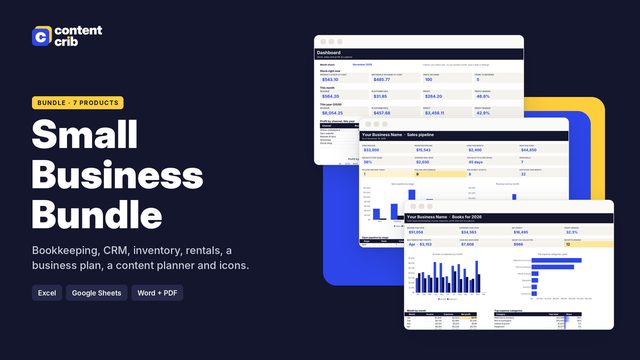 The template for thisSmall Business Spreadsheet Bundle $20.30 · 30% off→
What self-employment tax is
Employees split Social Security and Medicare taxes with their employer. When you work for yourself, you pay both halves. The IRS calls this self-employment tax.
- The rate is 15.3%. According to the IRS, that is 12.4% for Social Security plus 2.9% for Medicare.
- It applies to 92.35% of your net profit. The worksheet in Form 1040-ES multiplies net earnings by 0.9235 before applying the rate. That is why the real cost is about 14.1% of profit (0.9235 x 0.153), not the full 15.3%.
- It starts at $400. The IRS says you must pay self-employment tax and file Schedule SE if your net earnings from self-employment are $400 or more.
- The Social Security part has a ceiling. For 2026 it applies to the first $184,500 of combined wages, tips and net earnings. The Social Security Administration has set the 2027 figure at $192,300. The Medicare part has no limit.
- Higher earners pay a little more. An Additional Medicare Tax of 0.9% applies above $200,000 of income for single filers and $250,000 for married couples filing jointly.
- Half of it is deductible. You can deduct the employer-equivalent portion when you figure your adjusted gross income. That lowers your income tax, not the self-employment tax itself.
Self-employment tax is figured on net profit, which is income minus business expenses. It is not figured on every dollar that lands in your account.
A worked example
Say your business earns a net profit of $50,000 for the year.
- $50,000 x 0.9235 = $46,175 of net earnings subject to the tax.
- $46,175 x 0.153 = $7,064.78 of self-employment tax.
- Half of that, $3,532.39, is deducted when you figure adjusted gross income.
Federal income tax is then worked out on your whole return, and it depends on your filing status, your other income and your deductions. That part is different for everyone, which is why a fixed percentage from a stranger is only a starting point.
A simple set-aside method
- Find your own rate. Take the total tax on last year's return and divide it by last year's net profit. If you paid $9,000 of tax on $40,000 of profit, your rate was 22.5%.
- Round up. Add a few points if you expect to earn more this year or if your state taxes income. Rounding 22.5% up to 25% builds in a cushion.
- Move the money the day you are paid. Transfer that share of each payment into a separate savings account. Money that never sits in your spending account is much harder to spend by accident.
- Pay from that account each quarter. Anything left after you file your return is yours to keep.
- Check the rate every quarter. If profit is running well ahead of last year, raise the percentage.
If this is your first year, you have no return to work from. Start from the 14.1% self-employment tax floor, add an estimate for income tax, and adjust after your first quarter.
| Payment received | Set aside at 20% | Set aside at 25% | Set aside at 30% |
|---|---|---|---|
| $250 | $50.00 | $62.50 | $75.00 |
| $1,000 | $200.00 | $250.00 | $300.00 |
| $2,500 | $500.00 | $625.00 | $750.00 |
| $5,000 | $1,000.00 | $1,250.00 | $1,500.00 |
The percentages in the table are examples, not recommendations. Use the rate you worked out for yourself.
Who has to pay estimated tax
The IRS general rule is that you must make estimated payments if you expect to owe at least $1,000 for the year after subtracting withholding and refundable credits. If you also have a job, tax withheld from your paycheck counts toward the total.
You generally avoid an underpayment penalty if your payments and withholding cover the smaller of these two amounts:
- 90% of the tax for the current year, or
- 100% of the tax shown on last year's return. This rises to 110% if last year's adjusted gross income was more than $150,000 ($75,000 if married filing separately).
The second option is useful when your income jumps around. Last year's tax is a number you already know, so you can divide it into four equal payments. The IRS notes that you can be charged a penalty for paying late even if you are due a refund when you file.
2027 estimated tax due dates
The IRS splits the year into four payment periods. They are not equal quarters: the second period covers two months and the fourth covers four.
| Income earned | Payment due |
|---|---|
| January 1 to March 31, 2027 | Thursday, April 15, 2027 |
| April 1 to May 31, 2027 | Tuesday, June 15, 2027 |
| June 1 to August 31, 2027 | Wednesday, September 15, 2027 |
| September 1 to December 31, 2027 | January 15, 2028 (see note) |
Note on the last payment: January 15, 2028 is a Saturday. The IRS rule is that a payment due on a Saturday, Sunday or legal holiday is on time if you make it on the next business day. Monday, January 17, 2028 is the Martin Luther King Jr. Day holiday, so the deadline should move to Tuesday, January 18, 2028. Confirm the exact date on the 2027 Form 1040-ES when the IRS publishes it.
One more date to remember: the final payment for tax year 2026 is due Friday, January 15, 2027.
Keeping the numbers in one place
The method only works if you know your profit as the year goes on. Our Small Business Bookkeeping Spreadsheet has a Settings tab where you enter your own set-aside percentage, and its Quarterly tab shows income, expenses, profit and the amount to set aside for each quarter at that percentage. It does not calculate your tax for you. It applies the rate you choose to the profit you have logged.
Frequently asked questions
Is 30% enough to set aside for taxes?
It depends on your profit, filing status, other income and state. The only fixed piece is self-employment tax at about 14.1% of net profit. Use last year's return to find your own rate, then round up.
Do I set aside a share of income or of profit?
Tax is figured on net profit. Setting aside a share of every payment is simpler and usually saves more than you need if you have expenses. If your costs are high, such as materials for products you sell, base the percentage on profit instead.
What if I miss a quarterly payment?
The IRS may charge an underpayment penalty for the period you were short. Paying as soon as you can limits how long the shortfall lasts. A tax professional can tell you what applies to you.
Do I pay estimated tax if I also have a regular job?
Maybe not. Withholding from your paycheck counts. If withholding covers enough of your total tax to meet the rules above, or you expect to owe less than $1,000, the general rule does not require estimated payments.
Sources
- IRS, Self-employment tax (Social Security and Medicare taxes), page updated October 2026
- IRS, Estimated tax FAQs, 2026
- IRS, Form 1040-ES, Estimated Tax for Individuals, 2026
- Social Security Administration, 2027 Cost-of-Living Adjustment (COLA) Fact Sheet, 2026
This is general information, not tax advice. Tax rules change and your situation is your own. Check current IRS guidance or ask a tax professional.
Skip the blank page
The Small Business Spreadsheet Bundle includes the Small Business Bookkeeping spreadsheet, laid out and ready to use. $20.30, instant download.
Get the Small Business Spreadsheet BundleRelated guides
- How to Do Bookkeeping for a Small Business (Beginner Guide)
- Cash Basis vs Accrual Accounting: The Difference in Plain English
- Profit and Loss Statement for a Small Business: How to Make One
- Simple CRM Spreadsheet: What to Track and How to Set It Up
- Sales Pipeline Stages Explained (With Examples for Small Business)